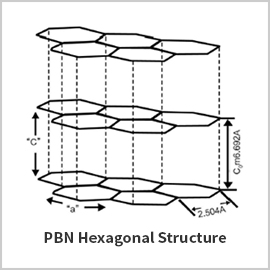
PBN is a particular material of ceramics. its sedimentary process
just like "Snowing" hexagon shaped PBN by dropping on graphite
material in parallel till to a certain thickness. After cooling, it becomes.
Main Features
· The product is white, non-toxic, non-porous and easy-marking.
· The purity is up to 99.99% and its surface is very compact.
· It has good hermeticity and high temperature resistance. Its intensity increases woth temperature and maximise at 2200℃
· It has many good properties such as acid-resistance, alkali-resistance, salt-resistance and reagent-organic-resistance. It is insoluble and nonreactive with most molten-metals , semiconductors etc. under high temperature.
· It has good thermal shock resistance and good conductivity. It has low coefficient of thermal expansion.
· It has high resistance, high dielectric-strength and low dielectric-constant. It has low magnetic loss tangent. It has good performance to allow microwave and infrared ray to pass through.
· It has distinct differences among mechanics performance, thermotics performance and electricity performance
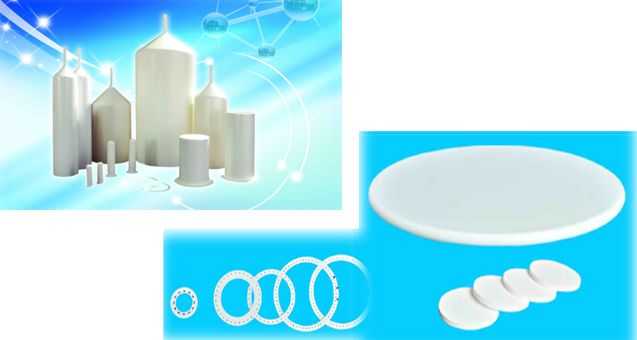
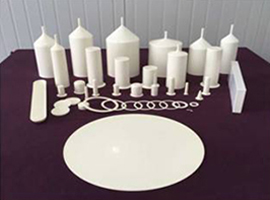
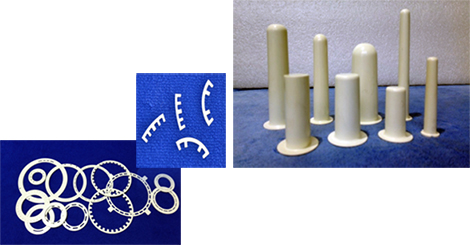
PBN Products
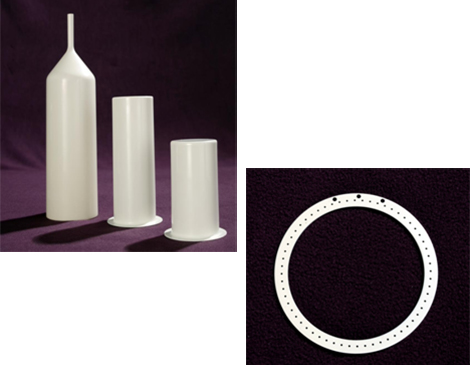
· Crucibles
· Machined plate products
· Tube
· Bottles
· Etc
PBN Products’ Usage
· Crucibles, Foundation bed of compounding semiconductor monocrystal and III-V synthetic materia
· LEC crucibles of GaAs monocrystal Inp monocrystal and GaP monoctystal in sity synthesis
· MBE crucibles for molecular beam epitaxy
· VGF crucible and VB crucibles
· Coating of PBN/PG composite heater
· Insulation coating of graphite heater
· Spray nozzle for high temperature insulation fluid
· MOCVD insulation Board
· Special-shaped crucibles and Coating of special- shaped graphite product
· Composite heater for chip annealing process
PBN Materiel property
Property
Unit
Date
Apparent Density
g/㎤
Board
2.0 -2.19
Crucible
2.0 -2.19
Tensile Strength
N/mm²
II
153.86
Bending Strength
N/mm²
II
243.63
┴
197.76
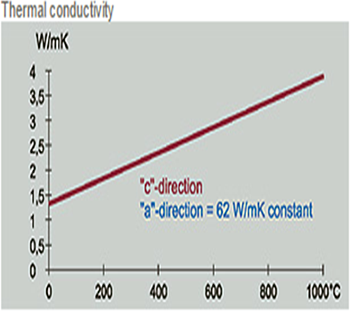
Thermal Conductivity
W/m-k (200℃)
ab
60
c
2.6
W/m-k (900℃)
ab
43.7
c
2.8
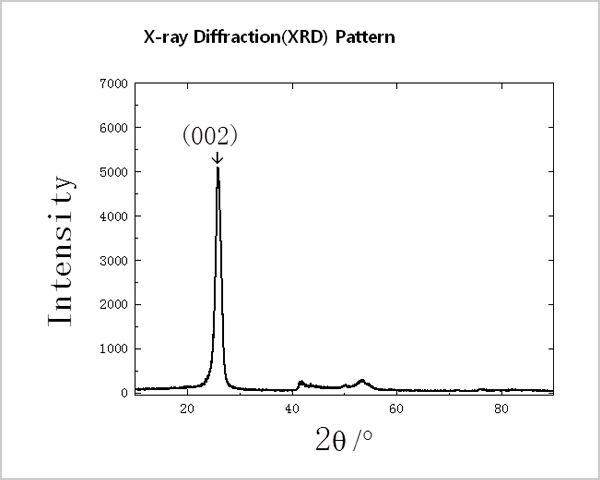
Lattice Constant
µm
a
2.504*10-10
c
6.692*10-10
Helium Transmissivity
㎤/s
1*10-10
Hardness (Knoop)
(ab plane)
solidity by microscope